


What Are the Best Platforms to Buy and Sell Cryptocurrencies? Crypto Investor's Top Choices
- Marcus Ellery, Protocol Analyst

- Jan 25
- 12 min read
Updated: Feb 2
Picking the right place to buy and sell crypto is honestly a headache—so many choices in 2026. If you’re new, Coinbase is still the go-to in the USA. Binance rules for high volume and deep liquidity. Kraken’s your friend if you care about security, and MEXC is great for low fees. Each one brings something different to the table, whether it’s the coins they offer, how much they charge, or the tools they put in your hands.

Honestly, the “best” exchange comes down to what you actually need. Some platforms are super simple—perfect for beginners who just want to dip their toes in. Others cater to pros who want to mess with futures, leverage, and all that jazz. Fees, security, and which coins you can buy or sell? Yeah, those matter too.
Let’s break down what really sets the top exchanges apart, what features are actually useful, and how to figure out which one matches your style.
Key Takeaways
Your experience level and priorities shape which crypto exchange fits best—there’s no one-size-fits-all
Fees, supported coins, security, and platform features vary a ton between exchanges
Centralized and decentralized platforms both have their perks for buying and selling crypto
Most Recommended Platforms for Buying and Selling Cryptocurrencies
Crypto exchanges aren’t all built the same. Some are perfect for newbies, others are loaded with advanced features and low fees for serious traders. Here’s a quick look at who stands out.
Coinbase: Best for Beginners
Coinbase is hands-down the easiest way to get started with crypto. You won’t get lost in menus or jargon—the interface is clean and actually makes sense.
You get access to 300+ cryptocurrencies and a fee structure that’s pretty transparent. Maker fees run from 0.00% to 0.40%, taker fees from 0.05% to 0.60%. There’s no minimum deposit, so you can start small.
Key Features:
Loads of educational content for every level
Available in 172 countries
Use it on web, desktop, or mobile
FDIC insurance for your cash balances
Coinbase offers both simple and advanced charting. Beginners can stick to basic market cap and volume charts, while more experienced folks can dig into Fibonacci tools and projections. It’s a centralized exchange (CEX) with tough security, so it’s a solid pick for anyone just starting out.
Kraken: Best for Low Fees and Security
Kraken’s been around since 2011 and built a reputation for security and low fees. Over 15 million clients in 190+ countries trust it—not bad.
There’s a basic platform and a pro version. The basic side charges a flat 1% per trade. Kraken Pro drops that to 0.00%–0.25% for makers and 0.08%–0.40% for takers. You get access to more than 540 cryptocurrencies, plus you only need $10 to get started.
Security Features:
Most assets stay in cold storage
Two-factor authentication is standard
Regular security audits
Advanced encryption
Kraken Pro is free for everyone and comes with all the bells and whistles: advanced order types, detailed charts, screening tools. It’s available almost everywhere in the US, except for a few states. Kraken balances ease of use with pro-level features, so it works for newbies and veterans alike.
Binance: Best for Advanced Trading and High Liquidity
Binance is the big dog—massive trading volume, deep liquidity, and hundreds of trading pairs. If you want to move big money without moving the market, this is the place.
Advanced traders get everything: spot, futures, margin, options. Over 350 cryptocurrencies, and the fees are some of the industry’s lowest. Active traders get volume-based discounts, with maker rates dipping as low as 0.02%.
The charting tools are powerful, with loads of technical indicators and customization. Binance isn’t just about trading—they’ve got staking, savings, and lending too. And if you want more control, Binance DEX lets you go decentralized.
Crypto.com: Best for Mobile and Rewards
Crypto.com nails the mobile experience. Over 150 million users in 100+ countries use it, and the app is actually good.
You can trade 400+ cryptocurrencies, with maker fees from 0.08% to 0.25% and taker fees from 0.18% to 0.50%. The minimum deposit is $20—not too steep.
Mobile Platform Benefits:
Visa Debit Card: Spend crypto anywhere and earn rewards
Earn Program: Passive income for holding coins
Staking Rewards: Lock up tokens for higher returns
Automated Trading: Recurring buys and advanced orders
Crypto.com even supports Bitcoin options and futures right from your phone. It’s a centralized exchange, but with features that appeal to both casual and hardcore users. The card is a nice touch if you want to use crypto for everyday stuff.
Best DEX and Top Decentralized Options
If you want total control over your coins, decentralized exchanges (DEX) are the way to go. Uniswap is the king here, running on Ethereum and leading the DEX pack by volume.
DEXs like Uniswap, PancakeSwap, and dYdX connect users directly using smart contracts. You keep your private keys and assets the whole time. Fees are usually lower—think 0.1% to 0.3% per trade.
DEX Advantages:
No account or ID checks
Direct wallet-to-wallet trading
Early access to new tokens
No single point of failure
Uniswap is best for Ethereum tokens, PancakeSwap for Binance Smart Chain, and dYdX for derivatives. You need to know your way around wallets and gas fees, though. DEXs aren’t for everyone, but if you’re comfortable with blockchain tech and want privacy, they’re hard to beat.
Types of Cryptocurrency Trading Platforms: Centralized vs Decentralized
Illustration showing two types of cryptocurrency trading platforms: a centralized platform with a secure building and digital screens on one side, and a decentralized network of connected devices exchanging cryptocurrency on the other side.
Crypto trading platforms fall into two camps: centralized and decentralized. They’re pretty different in how they work.
Centralized Crypto Exchanges (CEX): Features and Pros
Centralized exchanges are run by companies, kind of like banks for crypto. They hold your funds, process trades, and take care of all the back-end stuff.
To use them, you’ll need to make an account and verify your identity. The exchange keeps your crypto in its wallets and matches buyers and sellers with order books.
Key Features:
Beginner-friendly interfaces
Fast trades and high liquidity
24/7 customer support
Easy ways to buy crypto with fiat (bank, card, etc.)
Advanced trading tools and charts
Main Advantages:
High liquidity so you can trade big amounts fast
Lower fees than most DEXs (at least on the network side)
Regulated and insured—more protection for users
Password recovery is possible if you mess up
Coinbase, Binance, and Kraken are the big names here. They process millions of trades daily and make it easy for anyone to start.
Decentralized Crypto Exchanges (DEX): Features and Pros
Decentralized exchanges run on blockchain and smart contracts. No company holds your funds or controls the platform.
You connect a Web3 wallet (like MetaMask) and trade peer-to-peer. Smart contracts handle the swaps—no middleman.
Key Features:
No accounts or KYC needed
You control your private keys
Built on DeFi protocols
Wallet-to-wallet trades
Access to the newest tokens
Main Advantages:
Self-custody—your coins, your rules
Privacy—no personal data required
Global access—no borders, no gatekeepers
No risk of the company going bust or locking your funds
Uniswap and PancakeSwap lead the DEX world. If you care about privacy and control, these are your best bet.
Key Differences and When to Choose Each Type
So, which should you use? Depends on your comfort level and what you want out of trading.

Centralized exchanges are best if:
You’re new to crypto
You need to buy with fiat
You want customer support
You trade big or often
Decentralized exchanges are better if:
You’re comfortable with wallets and DeFi
Privacy and control matter most
You want to trade new or niche tokens
You’d rather skip the ID checks
Most people start with centralized exchanges because they’re easy and safe. DEXs are great once you know your way around and want more freedom.
Plenty of traders use both. They’ll keep some crypto on a CEX for quick trades and stash the rest in a wallet for DEX trading when needed.
Essential Features to Evaluate When Choosing a Crypto Trading Platform
Picking a crypto platform isn’t just about the brand name. You’ve got to look at security, the coins on offer, fees, and how easy it is to use. These things affect both your safety and how smooth your trading experience is.

Security Measures and User Protection
Security is non-negotiable. The best exchanges make two-factor authentication mandatory, so you’re not just relying on a password.
Most keep 90–95% of user funds in cold storage—offline and away from hackers. Only a small chunk sits in hot wallets for quick withdrawals. Private keys get locked down with encryption and multi-signature setups.
Some exchanges back up your funds with insurance (like SAFU) in case something goes wrong. A few also team up with compensation programs that’ll cover up to $20,000 per claim. Proof-of-reserves audits are a good sign—they show the exchange actually has the assets they say they do.
Withdrawal whitelisting is another smart feature. You can lock withdrawals to certain addresses, so even if someone hacks your account, they can’t just send your crypto anywhere.
Supported Coins and Assets
The number of coins you can trade varies a lot. Big exchanges usually have BTC, ETH, and other heavy hitters like Solana and Cardano. Some platforms stick to 250–350 coins, while others go wild with 1,600+ trading pairs.
If you’re into altcoins, look for platforms with a broad selection—not just the big names. Stablecoins (USDT, USDC, etc.) help you park funds between trades. Some exchanges list new meme coins and tokens fast through launchpad programs.
Liquidity matters too. High volume means you can buy or sell without moving the price much. The busiest platforms handle billions in trades every day.
Spot trading is the standard, but many exchanges also offer futures, margin, and options for those who want to get fancy.
Fee Structure: Maker, Taker, and Hidden Costs
Trading fees can eat into your profits, especially if you're an active trader. Most platforms split their fees into maker and taker categories. If you place a limit order that sits on the order book, you're a maker. If you fill an existing order right away, you're a taker.
Spot trading fees usually land somewhere between 0.1% and 0.6% per trade. Maker fees are usually lower—sometimes even zero on exchanges that want to attract more liquidity. Taker fees tend to hover between 0.02% and 0.1%, but it really depends on the platform and how much you're trading.
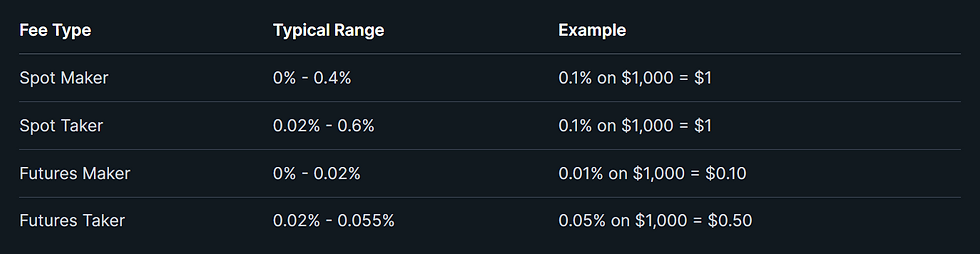
Deposits and withdrawals come with their own set of fees. SEPA bank transfers are usually cheap or free, but wire transfers can cost $10 or more each time. If you use a credit card to deposit, expect to pay 3-5% in processing fees.
Spreads—the gap between buy and sell prices—are another sneaky cost. Some exchanges tack on a 0.5% spread on top of their trading fees. You might also run into minimum deposit requirements, which typically range from $10 to $100 depending on how you fund your account.
Trading Experience and Platform Usability
A good trading platform should feel powerful but not overwhelming. New traders appreciate simple buy/sell screens that work with major fiat currencies like USD, EUR, AUD, and CAD. More experienced folks want real-time order books, advanced charting, and a range of order types.
Mobile apps really matter these days. The best ones let you do pretty much everything you could do on a desktop. Solid wallet integrations make it easy to move crypto between your exchange account and your own storage. Quick and flexible funding options—bank transfer, debit card, or payment processors—are a big plus.
Customer support is all over the map. Some exchanges have 24/7 live chat, while others stick to email support that might take a few days. Multilingual help is great if you’re not trading in English. Demo accounts are a nice touch for testing strategies risk-free.
Platform speed can make or break your trading during wild market swings. The top exchanges process over a million transactions per second, so they don’t freeze up when things get crazy. Order types like stop-loss, trailing stop, and limit orders give you more control over your trades.
Advanced Trading Tools and Extra Features
Most big crypto platforms go beyond basic buying and selling. They pack in features for more advanced strategies and ways to earn on your holdings. You’ll find leveraged trading, passive income products, and a bunch of support resources for all skill levels.
Derivatives and Margin Trading
Derivatives let you bet on crypto prices without actually owning the coins. Futures are the most popular—traders agree to buy or sell crypto at a set price on a future date. Binance, MEXC, and Bitget all offer both spot and derivatives markets with different contract types.
Margin trading lets you borrow money to boost your position. For example, 10x leverage means you can control $10,000 in crypto with just $1,000. It can multiply your gains, but also your losses—so tread carefully.
Derivatives trading usually comes with lower fees than spot. Binance charges 0.02% for makers and 0.05% for takers on futures. MEXC lets makers trade futures for free and charges 0.02% for takers. Most platforms ask you to move funds into a separate derivatives wallet before you get started.
Advanced order types help you manage risk. Limit orders let you pick your entry and exit prices. Stop-loss orders can close out your trade automatically if the price moves against you.
Automated and Copy Trading
Copy trading is pretty cool if you want to follow the moves of more experienced traders. LBank's copy trading shows lead traders with crazy-high ROI numbers (over 6,000% in some cases), so newbies can try to ride their coattails. Lead traders earn a cut of the profits when people copy them.
Trading bots handle trades automatically based on rules you set up. They watch the markets 24/7 and can react way faster than any human. Some exchanges build bots right in, while others let you connect your own.
The main draw? You save time. Once you pick a lead trader or set up your bot, you don’t have to check in every hour. Bots trade around the clock—even when you’re sleeping.
There’s a catch, though. If your lead trader makes bad calls or your bot glitches during a wild market, you could lose money fast. It’s smart to keep an eye on things and actually understand the strategy you’re using.
Staking, Lending, and Earning Rewards
Staking is all about locking up your crypto to earn rewards. Binance offers Simple Earn with flexible and locked options. Flexible staking means you can pull out your funds anytime, but locked staking pays more if you’re willing to commit for a set period.
Lending programs let you loan out your crypto for interest. Platforms use your funds for margin trading and other services. LBank has deposit pools with different APY rates, depending on the token and how long you lock it up.
Launchpads and launchpools give you early access to new tokens. You can stake your crypto to join token sales (launchpad) or lock it up for a chance at free token airdrops (launchpool). Binance and LBank have both run projects in GameFi, AI, and DeFi. Some LBank launchpool users scored up to 2,900% gains on tokens like CELA.
Rewards can be all over the place. Staking usually pays 5-15% annually on big-name coins. New token launches might offer way higher returns—but they’re riskier, too.

Educational Resources and User Support
The best platforms for beginners offer plenty of learning materials—video tutorials, guides, and practice accounts. Paper trading is handy for testing strategies without putting real money on the line.
A user-friendly interface makes a huge difference. Instant buy options help beginners get started, while advanced charting tools keep pros happy. Coinbase does a good job of balancing both with basic and advanced views.
Customer support is a mixed bag. Some sites have 24/7 chat, others rely on email tickets. FAQ sections can be helpful, but sometimes you just want a real person. Response times range from a few minutes to a few days.
High-volume traders sometimes get a dedicated account manager to help with tech issues, verification, or platform features. Bigger exchanges often run webinars and publish market analysis reports, which can be useful if you want to dig deeper.
Frequently Asked Questions (FAQs)
Transaction fees jump all over the place—some exchanges charge less than 0.1%, while others go past 1%. Security features and user interfaces can be wildly different, too, depending on whether they’re built for beginners or pros.
Which cryptocurrency exchanges offer the lowest transaction fees?
MEXC stands out with 0% maker fees on spot trading and 0.2% for takers. ByBit also keeps things cheap—0% for spot trades at first and 0.01% maker fees on futures.
Binance charges 0.1% for spot trades and drops to 0.02% for futures makers. KuCoin has a flat 0.1% fee for all trading pairs.
PrimeXBT sticks to 0.05%, and OKX charges 0.08% for makers and 0.10% for takers. Most of these platforms offer discounts if you trade higher volumes.
What are the most secure platforms for trading cryptocurrencies?
Kraken registers with FinCEN in the US and takes security seriously. They’ve built a reputation for reliability and layer on multiple security measures.
Coinbase follows strict US regulations and even offers FDIC insurance on USD balances. They keep 98% of customer funds in offline cold storage.
Binance uses two-factor authentication, withdrawal whitelists, and runs a Secure Asset Fund for Users (SAFU) to cover potential breaches.
Can you recommend any user-friendly cryptocurrency trading platforms for beginners?
Coinbase is probably the easiest for new users. It’s got big, clear buy and sell buttons and straightforward navigation. Their educational resources help beginners get up to speed.
eToro specializes in social trading, letting you copy experienced investors. The layout is clean and not too intimidating.
Crypto.com has a simple mobile app—just a few taps and you’ve bought your first coin.
What platforms support a wide range of cryptocurrencies for trading?
MEXC lists a whopping 1,521 cryptocurrencies, so you can find all sorts of new and niche tokens.
KuCoin has 806 coins across its pairs and adds new ones pretty quickly after launch.
Binance covers 385 cryptocurrencies, including most big and mid-size projects. ByBit offers 331 coins with 608 trading pairs.
How do the top cryptocurrency platforms ensure the safety of their users' funds?
Exchanges keep most funds in cold storage, so hackers can’t reach them. Usually, 90-98% of customer assets stay offline in secure wallets.
Two-factor authentication adds an extra hurdle for logins. Withdrawal whitelists let you lock down where your crypto can go.
Insurance funds step in if there’s a security breach or platform failure. Most platforms run regular security audits and use encryption to protect your data.
Are there any cryptocurrency platforms that offer additional financial services like staking or lending?
Kraken lets you stake a bunch of different cryptocurrencies, so you can actually earn some passive income just by holding your coins there. They cover Ethereum, Polkadot, Cardano, and a handful of other proof-of-stake tokens.
Bitfinex focuses more on crypto lending. You can lend out your assets to other traders, and the interest you earn depends on what’s happening in the market at the time.
Binance mixes things up with both staking and lending options under its Earn platform. Users get to pick between flexible savings accounts or locking up their tokens for set periods, each with its own reward rates.


Comments